



168-170 Borough Road, Middlesbrough, TS1 2EJ - 01642 242888
Mobile Nav
FREE DELIVERY IN THE TEESSIDE AREA - FURNISHING HOMES SINCE 1920
Basket Icon
x

15th Sep 2025
Riser Recliner Chairs: A Practical Buyer’s Guide (and why Celebrity’s Cloud Zero Hollingwell stands out)
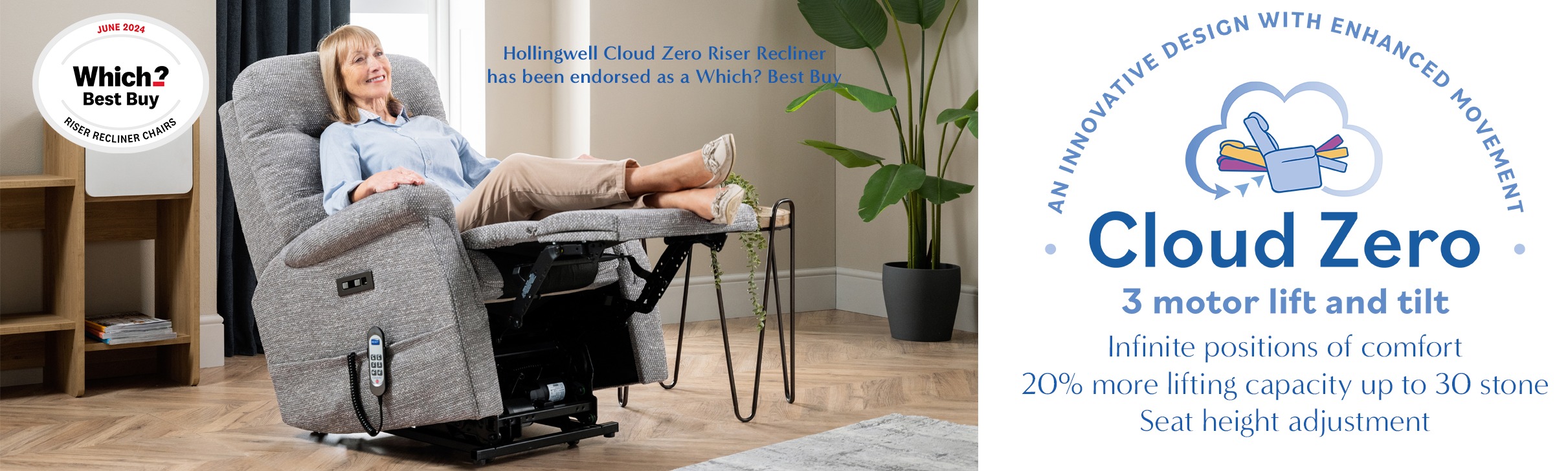
Celebrity Hollingwell riser recliner in Cloud Zero action with Which? Best Buy badge

Riser Recliner Chairs: a practical buyer’s guide from Race Furniture, Middlesbrough

Considering a riser recliner chair for yourself or a family member? This independent guide covers mechanisms, sizes and materials — with a closer look at Celebrity’s Cloud Zero action and the Hollingwell range’s award-winning credentials.

Celebrity Furniture British Craftsmanship Cloud Zero technology roundel BFM - British Furniture Manufacturers

What is a riser recliner chair?

A riser recliner is a powered armchair that gently assists you to stand and sit, then reclines for comfort. Most use one, two or three motors:

  • Single-motor: back and footrest move together — simple and budget-friendly.
  • Dual-motor: back and footrest move independently — more positioning options.
  • Three-motor (with seat-tilt): adds independent seat-tilt for very fine posture control (typical of Cloud Zero actions).

Cloud Zero action — what it does and why it matters

Cloud Zero is Celebrity’s next-generation lift-and-tilt design. It offers a deeper, more supportive tilt for relaxation, a smooth confidence-boosting rise to stand, and independent seat-tilt on three-motor chairs for precision comfort.

At a glance

  • Deeper tilt for “floating” pressure relief
  • Smooth, stable assist to stand
  • Independent seat-tilt (3-motor)
  • Available across multiple sizes
Leather Hollingwell showing Cloud Zero seat-tilt posture
Cloud Zero shown in a supportive seat-tilt — backrest remains upright while the seat gently elevates.

Hollingwell by Celebrity: the Which? Best Buy riser recliner

Hollingwell Cloud Zero 3-Motor combines supportive cushioning with precise adjustability. Independent reviewers have highlighted the ease of getting in and out and the ability to fine-tune the posture for reading, relaxing or napping.

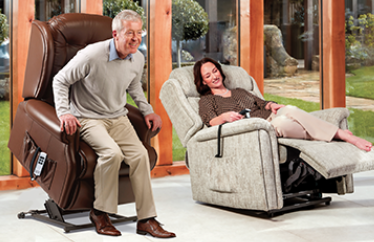
Hollingwell lifestyle scene — one chair rising, plus a sofa and a leather chair
Lifestyle: one Hollingwell chair rising with Cloud Zero, shown with matching sofa and leather chair.
Hollingwell cutout rising, facing right
Cut-out: Hollingwell rising motion, illustrating the balanced stand-assist pathway.
FeatureWhy it helps
Cloud Zero 3-motor actionIndependent control (including seat-tilt) for tailored pressure relief and comfort.
Optional powered headrest & lumbarFine-tune neck and lower-back support without shifting your posture.
Multiple sizesBetter fit = better biomechanics when standing and sitting.
Fabric or leather upholsteryChoose the feel and care routine that suits your home.
Close-up of Hollingwell leather with adjustable headrest brought forward
Adjustable headrest brought forward — supportive for reading or TV without over-reclining.
Hollingwell with Which? Best Buy badge
Hollingwell’s Which? Best Buy recognition signals strong performance in independent testing.

How to choose the right riser recliner

1) Size & fit

Your feet should plant flat when seated, with hips level to or slightly above knees. A Petite chair helps shorter users avoid dangling feet; larger sizes support longer legs and higher weights.

2) Mechanism

If you need precise positioning for reading, napping or swelling management, a three-motor Cloud Zero model is worth considering. Dual-motor suits most daily tasks. Single-motor is simple for occasional use.

3) Upholstery & care

Fabric riser recliners feel soft and can pair with pressure-relief foams; leather riser recliners are wipe-clean and durable.

4) Support features

Consider powered headrest, lumbar support, handset layout, battery backup and wall clearance. Try different handset configurations to ensure the buttons feel intuitive.

A quick visual recap

Leather Hollingwell showing seat-tilt only (Cloud Zero)
Seat-tilt only (Cloud Zero) — back upright, pelvis gently elevated.
Cloud Zero roundel
Cloud Zero technology badge.

Want to compare in person?

Trying chairs in person is the best way to confirm fit and controls. We can demonstrate Cloud Zero’s movement, headrest and lumbar adjustments, and talk through sizing.


Written by Race Furniture of Middlesbrough. This guide is informational; specifications can vary by grade and configuration. Always try a chair in person to confirm fit and function.

25th Jun 2025
The Chesterfield Sofa
Discover the enduring charm of the Chesterfield sofa—an 18th-century British icon renowned for its deep button-tufting, rolled arms, and timeless silhouette. Hand-crafted from FSC-certified hardwood and upholstered in premium leather or eco-friendly fabrics, each piece promises decades of comfort, characterful patina, and responsible luxury. Perfect for both traditional and contemporary interiors, our bespoke Chesterfields blend heritage craftsmanship with sustainable design.
01st May 2025
8 Signs It’s Time to Replace Your Mattress

A quality night’s sleep starts with the right mattress. Over time, even the best mattresses lose their support, comfort, and hygiene. If your mattress shows any of the following signs, it’s time to invest in a replacement for the sake of your sleep health and well-being.

1. You Wake Up Unrefreshed and Aching

If you’re consistently waking up with stiff muscles, back pain, or general discomfort, your mattress may no longer be providing the support you need. A worn-out mattress fails to align your spine properly, leading to aches and decreased sleep quality.

2. You Don’t Have Enough Space to Sleep Comfortably

Feeling cramped at night or constantly rolling into the middle? That’s a clear sign your mattress is too small for your sleeping needs. Upgrading to a larger size can make a world of difference.

3. You’ve Had Your Mattress for More Than 7–10 Years

Most experts recommend replacing a mattress every 7 to 10 years. Even with good care, materials break down, and support diminishes over time.

4. You’ve Slept Better in a Different Bed

Whether it’s at a hotel, a friend’s house, or a showroom, if other beds feel noticeably more comfortable, it’s not just your imagination—your mattress has likely passed its prime.

5. It Sags and You Roll into the Middle

Visible sagging or a noticeable dip in the center means your mattress can’t support your weight evenly. This leads to poor posture during sleep and pressure points that disrupt rest.

6. It Makes Suspicious Noises in the Night

Creaking, squeaking, or clicking can signal that internal springs or support structures are broken or worn out.

7. It Has Embarrassing Stains

Stains from spills, sweat, or accidents aren’t just unsightly—they can harbor bacteria, mold, and allergens that affect your health.

8. The Base Has Dips or Is Lumpy and the Castors Are Loose or Worn

A stable base is essential for even support. If your bed frame or base shows dips, lumps, or faulty castors, it compromises the mattress performance and comfort.

If any of these signs sound familiar, it’s time for a new mattress. For your health, hygiene, and best night’s sleep, don’t wait!

Not sure if you need a new mattress? Try Bed Advice UK’s Bed MOT for a professional assessment: Bed MOT

Visit Us In-Store to Find Your Perfect Mattress

#MayBeTimeForANewMattress

30th Nov -0001
Silentnight UltraGel™ Technology: What It Is & How It Works

Silentnight UltraGel™ Technology: What It Is & How It Works

Comfort, support and temperature regulation often define how well we sleep. Silentnight’s UltraGel™ range is designed to address this trio with a gel-infused, breathable comfort layer combined with pocket-spring support and cool-to-touch covers on selected models.

1) What is UltraGel™?

UltraGel™ is a gel-infused comfort layer used across selected Silentnight mattresses (for example, models that feature 1400, 2000 or 3000 pocket spring systems). It is engineered to combine pressure relief with a responsive feel that makes it easy to change position, while aiming to reduce partner disturbance when paired with independent pocket springs.

2) How UltraGel™ Works

a) Gel-infused, breathable comfort layer

The UltraGel™ layer blends gel with an open-structure foam to encourage airflow through the comfort surface. This design helps the mattress feel fresher through the night and provides cushioned pressure relief around common hotspots such as shoulders and hips.

b) Responsive bounce-back and motion control

Unlike slow-recovery foams, UltraGel™ is formulated for quicker rebound. That responsive “bounce-back” helps you turn more easily and, together with pocket springs, can limit the transfer of movement across the mattress.

c) Paired with Mirapocket® (and on some models, Miracoil®) support

UltraGel™ comfort layers sit above Silentnight support systems. Mirapocket® springs are individually encased to distribute weight evenly and provide targeted support. Some models may combine full-size pocket springs with additional mini-springs for a plusher top feel. Other models may use Miracoil® continuous springs for a different support profile.

d) Cool-to-touch sleep surfaces

Selected UltraGel™ mattresses include cool-to-touch fabrics designed to deliver an instant cool sensation at the surface, complementing the breathability of the gel-infused comfort layer.

3) Key Benefits

  • Pressure relief with easy movement: the gel-infused layer gently contours while remaining quick to respond as you move.
  • Breathable comfort feel: an open-structure comfort layer is designed to encourage airflow for a fresher sleep surface.
  • Reduced partner disturbance: responsive foam paired with independently moving pocket springs helps isolate movement.
  • Zoned support options: pocket-spring layouts (and, in some models, mini-springs) provide targeted support across the mattress.
  • Cool-to-touch covers on select models: surface fabrics engineered to feel cooler to the touch from the moment you lie down.

4) Who UltraGel™ May Suit

  • Hot or warm sleepers seeking a mattress surface designed for breathability and cool-to-touch fabrics.
  • Couples who prefer comfort layers that rebound quickly and spring systems that are engineered to limit motion transfer.
  • Sleepers with pressure points wanting cushioned relief around shoulders, hips and back without a “stuck” feeling.
  • Combination sleepers who change position frequently and value a surface that responds quickly.

5) Buying & Care Considerations

  • Model differences: firmness levels, spring counts (e.g., 1400 / 2000 / 3000) and top constructions (pillow-top or box-top) vary by model.
  • Base compatibility: use a supportive bed base. If slatted, ensure slats are evenly spaced and in good condition.
  • Rotation: rotate head-to-toe periodically as recommended for the specific model to help even out settlement.
  • Manufacturer guarantee: guarantees are provided by the supplier/manufacturer. Terms and duration depend on the specific model and require proof of purchase.

Specifications can vary between models in the UltraGel™ range. Please review the details of the exact mattress model you’re considering.

UltraGel™ and Mirapocket® are trademarks of Silentnight. Product features and specifications may change without notice.

30th Nov -0001
Silentnight Memory Cool™ Technology: What It Is & How It Works

Silentnight Memory Cool™ Technology: What It Is & How It Works

Memory foam is brilliant for pressure relief — but it can sometimes feel a bit too warm. Silentnight’s Memory Cool™ range keeps the sink-in, body-hugging feel people like, but mixes it with graphite-infused memory foam and breathable finishes to help draw heat away from the body. Underneath, you’ll usually find zoned pocket springs (e.g. 1000, 2000 or 3000 Mirapocket®) for tailored support and better motion control.

1) What is Memory Cool™?

Memory Cool™ is Silentnight’s upgraded, cooling version of memory foam. It’s still a pressure-relieving comfort layer, but it has graphite particles running through it to make the surface up to 15% cooler than standard memory foam. You’ll see it on mattresses like the Silentnight Memory Cool 1000, Memory Cool 2000 Pillow Top and Memory Cool 3000 Box Top, each one combining that foam with different spring counts and tops.

2) How Memory Cool™ Works

a) Graphite-infused, temperature-managing foam

The star ingredient here is graphite-infused memory foam. Graphite conducts heat away from your body, so instead of warmth getting trapped around your shoulders and hips, it’s dispersed through the foam. That’s how Silentnight can claim a cooler feel compared with ordinary visco layers.

b) Pressure relief without losing that “hug”

Because Memory Cool™ is still memory foam at heart, it moulds to you: it spreads weight away from hotspots, softens around joints and gives that traditional, cocooned feel. It’s ideal for side sleepers and anyone who prefers a plusher top.

c) Paired with Mirapocket® (and sometimes Miracoil®) support

The foam sits on top of Silentnight’s own support systems. Most cooling models use 1000, 2000 or 3000 Mirapocket® springs — individually encased so they move separately, follow your shape and help stop partner disturbance. Some retailer-specific models may use Miracoil® continuous springs instead, for a slightly different price point and feel.

d) Breathable, soft-touch covers

To complement the cooler foam, Memory Cool™ mattresses are finished in breathable, soft-touch covers (and often a pillow-top or box-top). These help airflow around the mattress and prevent the surface from feeling clammy.

3) Key Benefits

  • Cooler than standard memory foam: the graphite-infused layer is engineered to shed heat instead of storing it.
  • Contour + support combo: you get a deep, sink-in comfort layer on top and pocket springs underneath to keep the spine aligned.
  • Reduced partner disturbance: motion is absorbed by the foam and then further isolated by individually wrapped springs.
  • Choice of spring counts: 1000 for balanced, everyday support; 2000 or 3000 (with box/pillow tops) for a more indulgent, plusher feel.
  • Fresher-feeling surface: breathable borders and covers help moisture and warmth escape, so the mattress feels cleaner for longer.

4) Who Memory Cool™ May Suit

  • Hot-or-warm sleepers who like memory foam but don’t want to overheat on it.
  • Side sleepers who need the foam to give at the shoulder and hip.
  • Couples who want good motion isolation without switching to an all-foam mattress.
  • People with pressure-sensitive joints who’d benefit from a gentler top over a supportive spring core.
  • Anyone upgrading from a basic memory foam mattress and looking for something that feels a bit more “airy” and premium.

5) Buying & Care Considerations

  • Model differences: check the exact spec — some Memory Cool™ models are 1000-spring, others 2000 or 3000; some have pillow/box tops, others are straighter sided. This will change firmness, depth and price.
  • Base compatibility: place on a supportive base. If you’re using slats, make sure the gaps are not excessive and everything is in good condition so the springs aren’t forced out of alignment.
  • Rotation, not flipping: most of these mattresses are single sided. Rotate head-to-toe every few weeks at first, then every 1–2 months.
  • Allergies & hygiene: look for models with breathable borders and an anti-allergy or easy-care finish if this is a priority.
30th Nov -0001
Why are Pocket Springs Considered High Quality?
Pocket Spring Mattresses: Why They’re High-Quality & Who They Help

Pocket Spring Mattresses: Why They’re High-Quality & Who They Help

Pocket springs (sometimes called “pocketed” or “encapsulated” springs) are widely used in mid-to-premium mattresses because they offer something ordinary open-coil systems don’t: each spring is sewn into its own fabric pocket, so it can move on its own. That gives you more accurate body support, less partner disturbance and a mattress that generally lasts better. Add the right comfort layers on top (natural fibres, foams or pillow-tops) and you get a bed that supports healthy alignment for most sleepers.

1) What Are Pocket Springs?

A pocket spring mattress uses hundreds or even thousands of individual springs, each housed in a small fabric sleeve. Instead of being wired together like a traditional open-coil unit, these springs respond independently to the weight placed directly over them.

This design means your shoulders can sink more than your waist, your hips can be supported without throwing your spine out, and your partner’s movements are less likely to ripple across to you.

2) How Pocket Springs Work

a) Independent, body-following support

Because each spring is separate, the mattress can “map” itself to your body. Heavier areas (hips, midsection) compress the spring deeper, while lighter areas (lower legs, waist) compress it less — helping to keep the spine nearer its natural curve.

b) Zoned or varied spring counts

Many quality pocket mattresses use zones — firmer springs in the centre third for lumbar support, slightly softer springs at the shoulders. Higher spring counts (1200, 2000, 3000, sometimes in dual layers) don’t just mean “softer”; they often mean more contact points and better pressure spreading.

c) Better motion control than open-coil

Because the springs aren’t all tied together, energy doesn’t travel as far. If your partner turns over, the springs underneath them move, but the springs under you don’t have to — ideal for light sleepers and couples with different schedules.

d) Breathable core

Spring interiors allow air to move through the mattress more easily than dense all-foam builds. That helps heat and moisture escape, contributing to a fresher, more hygienic sleep surface.

3) Why Pocket Springs Are Considered High Quality

  • Precision support: more responsive to body shape than basic coil units.
  • Consistency over time: individual pockets help springs return to position, supporting durability when paired with good comfort layers.
  • Customisable feel: manufacturers can fine-tune firmness, zones and spring counts more easily.
  • Great partner performance: less roll-together, less “I can feel you getting out of bed.”
  • Works well with premium tops: pocket springs form a stable base for natural fillings, latex, memory or pillow-tops.

4) General Health & Posture Benefits

While a mattress can’t cure medical conditions, a well-built pocket spring mattress can make night-time more comfortable and reduce strain on joints and muscles.

  • Spinal alignment: independent springs help keep the spine closer to neutral, especially when combined with the right firmness for your weight.
  • Pressure relief: because the springs only compress where needed, bony areas (shoulders for side sleepers, hips) aren’t forced to take all the load.
  • Circulation-friendly: less pressure on one spot can help reduce pins and needles and the need to toss and turn.
  • Hygiene & breathability: the airy core can support a drier sleeping environment, which many people find more comfortable.

5) Who Pocket Springs May Particularly Suit

  • Couples: especially where one partner is heavier or moves more — the separation of movement helps.
  • People with mild back or shoulder discomfort: the mix of uplift + give can feel more supportive than a budget coil bed.
  • Side sleepers: pocket springs let the shoulder sink without the whole middle of the mattress bowing.
  • Heavier sleepers: a higher spring count or zoned pocket core can offer better central support than basic foams.
  • Warmer sleepers: the naturally ventilated spring unit is often cooler than solid cores.

6) Examples of Specific Health-Related Use Cases

a) Mild lower-back discomfort

A mattress with firmer central zoning can stop the hips sinking too far, which may help reduce morning stiffness for some people.

b) Shoulder sensitivity (common in side sleepers)

A medium pocket spring with a softer comfort layer on top can let the shoulder drop in while the springs underneath still support the ribcage area.

c) Pregnancy / changing body shape

Because pocket springs respond to current weight and position, they can stay comfortable as your body changes through pregnancy — especially when paired with a plusher top layer.

d) Partners with different body weights

Independent springs mean a lighter sleeper isn’t pulled into a heavier sleeper’s “dip,” which can help maintain better alignment for both.

7) Buying & Care Considerations

  • Spring count & gauge: more springs can mean more contouring, but look at the whole spec — wire thickness, zoning and top layers all influence feel.
  • Comfort layer choice: pocket springs are the support; choose the top for feel — memory foam for deeper hug, latex for bouncier support, natural fibres for breathability.
  • Base compatibility: use a sound divan or slatted base with sensible gap spacing so springs aren’t stressed.
  • Turn/rotate as advised: some pocket mattresses are tufted and two-sided (flip and rotate), others are single-sided (rotate only). Follow the maker’s schedule to help it wear evenly.
  • Allergies & cleanliness: look for breathable borders and removable or easy-care covers if dust sensitivity is a concern.
30th Nov -0001
Why Mattress Recycling Costs So Much (and Why It’s Worth It)

Why Mattress Recycling Costs So Much (and Why It’s Worth It)

Disposing of bulky household items has changed a lot in recent years. What used to be a simple “take it to the tip” job is now part of a more regulated, more environmentally conscious system — especially for mattresses. As a result, many furniture and bedding retailers now charge a separate fee to remove old items, and customers often wonder why.

This article explains the main cost drivers behind furniture and mattress recycling, why mattresses are treated differently from other items, and why retailers pass on those costs.

1. Bulky furniture and mattresses don’t just “go away”

When a retailer offers to collect an old sofa, bed or mattress, that item has to enter the waste stream legally. In the UK, that typically means:

  • transporting it using a licensed waste carrier,
  • taking it to a licensed waste transfer or recycling facility,
  • and retaining evidence that it was disposed of correctly.

Each of those steps has a cost. Retailers are not only paying for vehicle time and staff, but also for the gate fee charged by the facility. That is why most reputable retailers treat collection/disposal as a separate, pass-through service rather than absorbing it into the product price.

2. Why mattresses are more expensive than other items

Mattresses are one of the most problematic bulky waste streams. Several factors make them costlier to process than, say, a wooden chair or a flat-packed wardrobe.

a) Size and volume

Mattresses are large, awkward and don’t stack efficiently. They take up significant space in collection vehicles, which means fewer items can be collected per trip. Fewer collections per load = higher cost per item.

b) Mixed materials that need separating

A typical mattress can contain:

  • metal springs
  • foams
  • wadding/fibre
  • outer ticking/fabric
  • sometimes natural materials

To recycle these components, facilities often need to deconstruct the mattress. This is not fully automated everywhere — it can be labour-intensive and slow. Labour is one of the biggest contributors to recycling cost.

c) Contamination risk

Mattresses can arrive damp, stained or soiled. Contaminated items can’t always go through the normal recycling line and may have to be handled separately or even rejected. Facilities price in that risk, which pushes up the gate fee for all mattresses.

d) Limited landfill tolerance

There is continued pressure to keep bulky, non-biodegradable items out of landfill. That pushes mattresses into recycling and recovery routes, which are more expensive than simply burying the item. Retailers using compliant, environmentally responsible routes will therefore pay more than anyone cutting corners.

3. Why furniture retailers charge more for disposal

Most furniture and bedding businesses don’t profit meaningfully from taking old items away. They charge because their own costs have increased. Typical cost elements include:

  • Collection labour – staff to enter the property, remove the item safely and load it.
  • Transport – fuel, vehicle time, insurance and wear.
  • Site/gate fees – what the recycling or waste facility charges per mattress or per tonne.
  • Compliance and record-keeping – operating as a licensed carrier and providing audit trails.
  • Inefficiency of bulky waste – large items make every part of the process less efficient.

If a retailer uses a reputable site that actually recycles mattresses or processes them for material recovery, that downstream cost is higher — so the retailer’s charge to the customer is higher. In other words, higher customer charges often indicate that the item is being handled properly.

4. Why prices have risen in recent years

Several industry-wide pressures have made mattress and bulky waste disposal more expensive:

  • Rising labour costs at recycling facilities
  • Stricter environmental and duty-of-care requirements
  • Growing volumes of bulky waste, especially mattresses
  • Landfill tax and policy pressure nudging material into more expensive recycling routes

Retailers don’t control those elements, so they pass them through transparently as a disposal/collection fee.

5. Why it’s still worth doing properly

Even at a higher price point, responsible mattress recycling has clear benefits:

  • Environmental: materials such as steel and some foams can be recovered and reused, reducing waste.
  • Legal: using licensed carriers and sites helps avoid fly-tipping — which can be traced back to the original owner.
  • Reputational: retailers that offer compliant disposal support a circular, responsible approach to furniture and bedding.

For customers, paying a retailer to take a mattress away is often the simplest and safest route: the retailer already has the vehicle, the licence, and the relationship with a compliant facility.

6. Key message for customers

If a furniture or mattress retailer charges for collection and disposal, it is usually because:

  • mattresses are genuinely expensive to process,
  • legitimate sites charge for accepting them,
  • and the retailer is using the correct, lawful route.

Cheaper, unlicensed alternatives often mean the item is not being recycled — or worse, is being dumped — which can create costs and problems later.

30th Nov -0001
The Complete Guide to Upholstery Leather Types: Aniline, Semi-Aniline, Corrected Grain & More

The Complete Guide to Upholstery Leather Types: Aniline, Semi-Aniline, Corrected Grain & More

If you’re shopping for leather furniture, you’ve likely come across terms like aniline leather, semi-aniline leather, corrected grain, and bonded leather. But what do these labels actually mean? In this guide, we break down the different types of upholstery leather, how they’re made, and which one is best for your home—so you can shop with confidence.

What Is Upholstery Leather?

Upholstery leather refers to leather that has been processed and finished specifically for furniture use. Different finishing methods create different looks, durability levels, and price points. Understanding these differences will help you choose a leather that fits your lifestyle, budget, and style preferences.

1. Aniline Leather

What It Is

Aniline leather is dyed using soluble dyes that penetrate the hide without covering the natural surface. It is the most natural and luxurious type of leather.

Key Features

  • Shows natural markings and grain patterns
  • Soft, warm, and supple to the touch
  • Breathable and comfortable in all seasons
  • Ages into a beautiful patina

Best For

Low-traffic or adult-only spaces where the leather won’t be exposed to heavy wear.

Pros

  • Highest quality, most natural appearance
  • Develops character over time

Cons

  • Susceptible to stains and fading
  • More expensive than other types

2. Semi-Aniline Leather

What It Is

Semi-aniline leather is aniline-dyed but receives a light protective coating. This thin finish gives it moderately better resistance while retaining much of the natural look.

Key Features

  • Soft feel with slightly more surface consistency
  • Better stain and fade resistance compared to aniline
  • Natural grain still visible

Best For

Homes that want premium leather but need a bit more durability—families, pet owners, and everyday use.

Pros

  • Balanced durability and natural beauty
  • Easier to maintain than full aniline

Cons

  • Not as soft or organic-looking as pure aniline

3. Corrected Grain Leather

What It Is

Corrected grain leather is made from real leather but has imperfections buffed away. It is then embossed with an artificial grain and given a protective finish.

Key Features

  • Uniform appearance
  • Highly durable
  • More affordable than aniline or semi-aniline

Best For

High-traffic areas, rental properties, commercial settings, or families that want tough, easy-clean furniture.

Pros

  • Strong, scratch-resistant, and easy to clean
  • Consistent color and texture

Cons

  • Less breathable and not as soft
  • Lacks the natural look of higher-end leathers

4. Top-Grain Leather

What It Is

Top-grain leather is the second-highest quality after full-grain. The top layer of the hide is sanded to remove natural marks, then treated for a more uniform surface.

Key Features

  • Smooth, refined appearance
  • Durable and moderately soft
  • Very common in quality furniture

5. Full-Grain Leather

What It Is

Full-grain leather uses the complete hide with the natural surface intact. This is the most durable and natural type of leather available.

Key Features

  • Extremely strong
  • Ages beautifully with time
  • Unique, natural markings

Best For

Luxury buyers who want heirloom-quality furniture that lasts for decades.

6. Split Leather

What It Is

Split leather is made from the lower layers of the hide. It is often used on the sides or backs of furniture.

Key Features

  • Less expensive
  • Thicker and firmer
  • Usually finished with a protective coating

Best For

Budget-friendly furniture or parts of sofas that do not receive heavy use.

7. Bonded Leather

What It Is

Bonded leather is not true leather. It is made from leftover leather scraps blended with polyurethane or latex, then pressed into sheets.

Key Features

  • Low-cost alternative
  • Highly consistent in color and texture
  • Often used in budget furniture

Cons

  • Least durable type
  • Can peel or wear down faster

Which Upholstery Leather Is Right for You?

Choose Aniline Leather if you want:

  • The most natural, luxurious finish
  • Unique grain patterns
  • A soft, premium feel

Choose Semi-Aniline Leather if you want:

  • A balance of beauty and durability
  • Furniture that holds up better to everyday life

Choose Corrected Grain or Split Leather if you want:

  • Strong, easy-to-clean surfaces
  • A budget-friendly option

Choose Full-Grain or Top-Grain Leather if you want:

  • Long-lasting quality
  • Timeless aging and durability

Choose Bonded Leather if you want:

  • The lowest cost
  • A uniform, synthetic look

Final Thoughts

Understanding the different types of upholstery leather—aniline, semi-aniline, corrected grain, and more—helps you make an informed decision when buying leather furniture. Each leather type has unique advantages depending on your budget, lifestyle, and design preferences.

RACE FURNITURE
168-170 Borough Road
Middlesbrough
TS1 2EJ
01642 242888
OPENING HOURS
Monday 9:00 - 17:30
Tuesday 9:00 - 17:30
Wednesday 9:00 - 17:30
Thursday 9:00 - 17:30
Friday 9:00 - 17:30
Saturday 9:00 - 17:30
Sunday CLOSED
GET SOCIAL
REGISTERED
Race Furniture Of Middlesbrough Ltd
168-170 Borough Road
Middlesbrough
South Cleveland
TS1 2EJ
Reg No: 08380133
VAT No: 165522608
Please be aware that images are for illustration only. For example, suppliers only take images in one cover and the range might not be pictured in a middle price grade.

Abacus Furniture Solutions 2025